

 EUR/USD
  GBP/USD
  USD/ZAR
  EUR/INR
  EUR/GBP
  XAU/USD (Gold)
  XAG/USD (Silver)
  XM Global
  AvaTrade
  RoboForex
  IC Markets
  LiteFinance
  IUX Markets
  FP Markets
  South Africa
  Thailand
  Singapore
  Japan
Japan  Pakistan
  Malaysia
  Philippines
  Brazil
  Bangladesh
  Vietnam
  India
India 
Types of Forex Orders Explained
Order types are simply the different ways you tell your broker to enter or exit a trade. A market order fills right away at the current price, while a limit order waits for price to reach a level you choose before it triggers. A stop order activates once the market reaches the specified trigger price and is then normally executed as a market order. and a stop-loss is the one that closes a losing trade to protect your account. Knowing which order to use, and when, gives you far more control than clicking buy and sell on the spot.




A forex order is an instruction you give your broker to buy or sell a currency pair. It tells the broker both the price at which you want to trade and whether the trade should be executed immediately or only when specific conditions are met.
Forex trading mainly uses market orders and pending entry orders. A market order is executed immediately at the best available market price, which may differ slightly from the quoted price because of market movement. In addition, traders use protective exit orders such as Stop Loss, Take Profit and Trailing Stop to manage open positions automatically.
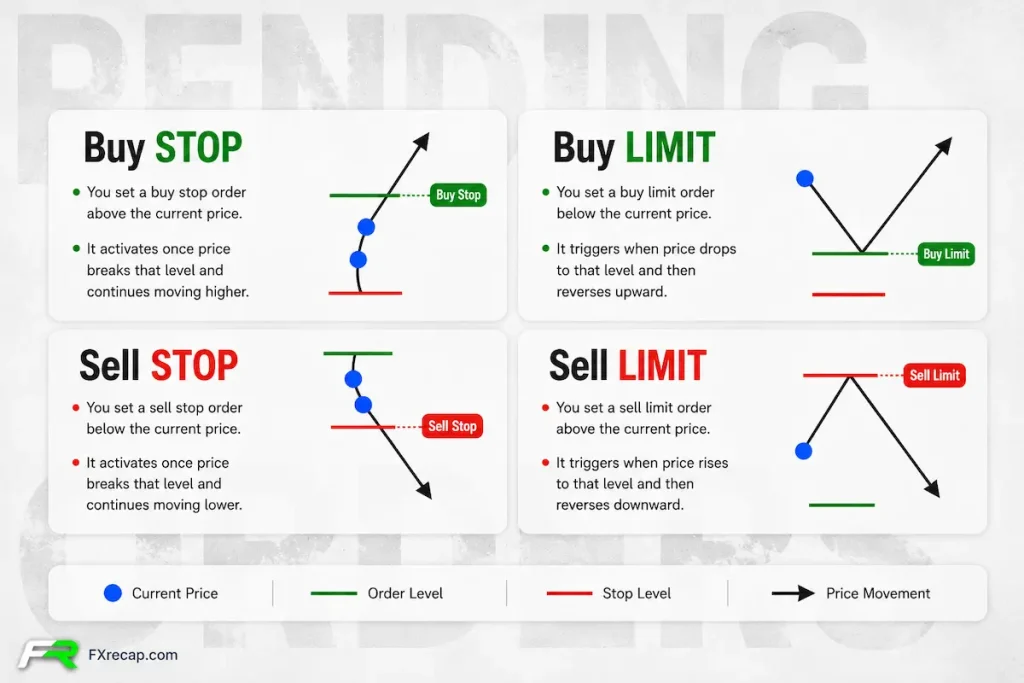
For most beginners, a simple rule of thumb is: use a market order when you want in or out now and the price is fair. Use a pending order when you have a plan and a level, and you would rather let the market come to you than chase it. The four pending order types are often confusing for new traders because two say buy and two say sell, but the key difference is where they sit. Below price you buy the dip or sell the breakdown. Above price you buy the breakout or sell the bounce.
One important point to understand from the beginning is this: The order type you pick decides your entry price, and your entry price has a direct impact on your trading risk. A market order in a fast move can fill several pips from where you clicked. Even a small price difference can affect your trading results, so the choice is not a small detail.
Market Orders
A market order is the simplest one. You click buy or sell, and the broker fills you at the best price available that instant. No waiting, no conditions.
The main drawback is that the final execution price may differ slightly from the quoted price. Your trade is executed at the best available market price at that moment, and in a fast or thin market that can be a few pips worse than the number you saw. This difference is known as slippage and can occur during periods of high volatility or reduced market liquidity. To keep it small, use market orders in busy sessions with tight spreads, like the London or New York hours, not in the quiet gaps or right around big news.
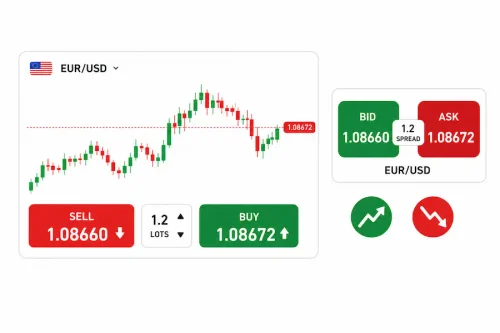
There is also the spread to remember. You buy at the ask and sell at the bid, and the small difference between them is a cost baked into every market order. On EUR/USD, if the bid is 1.1748 and the ask is 1.1750, a buy fills at 1.1750 and you are already two pips underwater the moment you enter.
Pending Orders
Pending orders allow you to plan your trades in advance. You set a level in advance, and the order waits there, ready to execute automatically, even when you are away from your trading platform. When price touches the level, it activates. This is how traders enter breakouts or pullbacks without constantly monitoring the market.
There are four, and an easy way to understand them is by using the following price ladder:imagine the current market price as the reference point, with two orders above and two below.
| Where it sits | Order | Why you would use it |
| Above current price | Buy Stop | Buy a breakout. You expect price to break higher and keep going. |
| Above current price | Sell Limit | Sell into strength. You expect price to rise to a level, then fall. |
| At current price | Market Order | Get in or out now, at the going price. |
| Below current price | Buy Limit | Buy the dip. You expect price to drop to a level, then bounce. |
| Below current price | Sell Stop | Sell a breakdown. You expect price to break lower and keep falling. |
Buy Limit vs Buy Stop
This is one of the most common areas of confusion for new traders, because both are buy orders and yet they sit on opposite sides of price.
A buy limit goes below the current price. The principle behind this order type is: I want to buy, but only at a better, lower price. You use it to catch a dip back to support, betting the price falls to your level and then bounces.
A buy stop goes above the current price. The principle behind this order type is: I only want to buy if price confirms bullish momentum by breaking higher. You use it to enter a breakout, betting momentum carries the move on once it clears a level like a recent high.
The sell versions mirror this exactly. A sell limit sits above price (sell into strength at a better, higher price), and a sell stop sits below (sell the breakdown once price cracks support). Limits chase a better price on a reversal. Stops chase momentum on a breakout. Once you understand this distinction, the different pending order types become much easier to remember.
Stop Loss and Take Profit
Exit orders are just as important as entry orders because they define your risk and profit objectives, because they close the trade for you. Both are pending orders, waiting to fire.
A stop loss closes a losing trade at a level you set, so a trade that goes wrong cannot keep increasing your trading losses. It is a stop order. Many professional traders use a stop-loss order to help manage risk, although its use depends on individual trading strategies and risk tolerance.
A take profit closes a winning trade at your target, locking the gain even if you are away from the screen. It is a limit order.
Most platforms let you attach both to a trade the moment you open it, so your exit plan is set before emotions influence your trading decisions.. One caution on placement: Many traders avoid placing stop-loss orders exactly at widely watched price levels, although market behaviour can vary. Give it a small buffer.
Trailing Stops and Stop-Limits
Once you are comfortable with the basics, you may also encounter these advanced order types.
A trailing stop is a dynamic stop-loss order that automatically adjusts as the market moves in your favour. You can set the trailing stop distance according to your trading strategy and your platform’s available settings, and as the trade goes your way, the stop follows at that distance. If price reverses, the stop stays put and locks in what you gained. It allows profitable trades more room to develop while protecting the profit, without you adjusting it by hand.
A stop-limit adds a price cap to a stop order. A plain stop becomes a market order when triggered, so it can fill with slippage. A stop-limit triggers at one price but will only fill down to a limit you set, protecting you from an unfavourable execution price. The main disadvantage is that in a fast move, price can blow past your limit and the order never fills at all. Useful, but not for beginners.
How Long an Order Lasts
When placing a pending order, you can also specify how long the order remains active. This setting is called time in force, and the two you will use most are simple.
- Good for Day (GFD): the order cancels itself at the end of the trading day if it has not been filled. Many brokers define the end of the trading day at around 5:00 p.m. New York time for rollover purposes, although trading hours and order policies vary by broker.
- Good Till Cancelled (GTC): the order stays live for days or weeks until it fills or you cancel it. This is useful when your planned entry level may not be reached for several days or weeks.
Immediate or Cancel (IOC) executes all or part of an order immediately, while any unfilled portion is cancelled. Availability depends on the broker and trading platform. A common mistake is assuming a pending order remains active after its expiry time. Always confirm your order’s expiration settings with your broker. If you want an order to persist, choose GTC intentionally.
A Worked Example
For example, assume EUR/USD is currently trading at 1.1000 and you think a break above 1.1050 will run higher, while a dip to 1.0950 would be a good value buy.
If you want the breakout, you place a buy stop at 1.1050. If the market reaches the trigger price, the order activates and is executed at the best available market price, which may differ slightly during fast-moving conditions, with a stop loss below the breakout level and a take profit at your target.
If instead you want the dip, you place a buy limit at 1.0950. Now you are hoping the price falls to your level and bounces, so you enter at a lower price than the current price. The same currency pair can require different order types depending on your trading strategy., and the order type is what makes each plan happen while you are away from the screen.
The mistake to avoid: placing a market order the instant news hits, entering after a strong price move that is already moving. That is when slippage is worst and the fill is significantly different from your expected execution price.
Which Order Should You Use?
The following guide can help you choose the appropriate order type for different market situations.
- Need immediate trade execution, in a liquid session? Market order.
- Expecting a breakout above a level? Buy stop up top, or sell stop below.
- Looking to enter on a pullback to value? Buy limit below, or sell limit above.
- Managing trading risk? Stop loss always, take profit for the target, trailing stop to let a winner run.
Most retail traders only need the core order types for day-to-day trading. Market, limit, stop, stop loss and trailing stop cover almost everything a trader ever does. Avoid placing unnecessary pending orders that become difficult to monitor or manage.
A Simple Way to Start
Practice using each order type in a demo account before trading with real money. Observe how a market order is executed. Set a buy limit below price and a buy stop above it, and watch which one triggers as price moves. Attach a stop loss and take profit to a trade so the exits are automatic. Practical experience helps reinforce these concepts far more effectively than reading alone.
As you gain experience, keep your trading process simple and disciplined. At FX Recap, the traders who use well-planned orders decide the price and the plan before entering a trade, rather than reacting to a moving candle. Market orders are suitable for immediate execution, pending orders help automate planned entries, and many traders use stop-loss orders as part of their overall risk-management strategy. Long-term trading success comes from using the right order type consistently within a well-defined trading plan.

FX Recap helps you find a trusted forex broker that keeps your trades secure and guides you through everything you need to know about FX instruments.

Ranjan Niskrity is a seasoned Crypto and Forex expert at FX Recap with over a decade of market experience. He specialises in verifying broker data, regulatory frameworks, and cryptocurrency trading insights. His rigorous fact-checking ensures every article meets the highest standards of accuracy.
Related Articles
 Education
7 min read
Education
7 min read

 Education
6 min read
Education
6 min read
 Education
7 min read
Education
7 min read
 Education
7 min read
Education
7 min read
